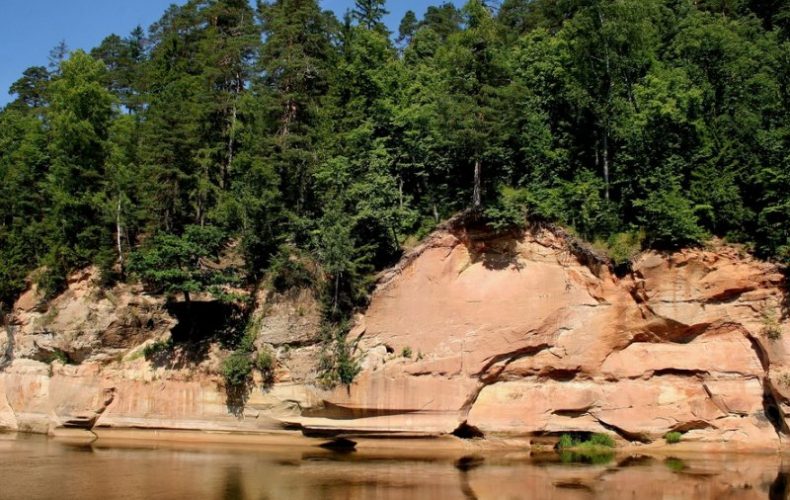
The Velnala cliffs are the largest rock outcrop on the Piķene escarpment, which is almost two kilometres long along the main bank of the Gauja Valley. The Velnala rock outcrop is 250 metres long and about 15 metres high. It began to form around 10 000 years ago in the Devonian era, but some formation is still taking place – there is active lateral erosion and large sandstone blocks often fall off the cliffs and into the deep Gauja gorge. If you look closely, you can see the patterns of ancient streams in the cliff face – different types of slope layering. The rocks around Velnala contain the richest assemblage of Devonian fish fossils, such as armadillos, and flora in the Sigulda area.
Velnala itself is located in the rock eight metres above the level of the Gauja. It was formed more than 10,000 years ago by lateral erosion of the river and the combined action of a now extinct underground spring. The intensive formation of the cave ended five millennia ago, when the Gauja was already flowing at the level of the first terrace. The depth of the cave reaches 35 metres.
Velnala is an ancient pagan cult cave. There are six holes in the ceiling, called the Devil’s Chimneys. The story goes that the devil, on his way from Judaži to Pabažiai, heard a rooster crowing above the Gauja River and, seeking salvation, ran into the cave, where he slept until the following evening. The devil, with his breath, made the walls of the cave pitch black and in the evening he sneaked out, ran into the opening of the Gauja, where he roared and hissed, occasionally tearing the careless visitors of the cave inside. It is said that not only the villain himself, but also Jakubovskis, the murderer of Turaida Rose-Majja, and his minion Skudrīte, who were hiding from a fair trial, lived in the Velnala.
Since a footbridge over the Gauja was built, the cave could only be viewed from the opposite bank of the river, but until 1980 it was not open to the public.
IMPORTANT
The cave is protected by the state as both a natural and historical monument. Please remember that the caves are located in the territory of the Gauja National Park and please treat the ancient geological natural monuments with understanding and respect, without damaging them.
Photos from Sigulda TIC archive.