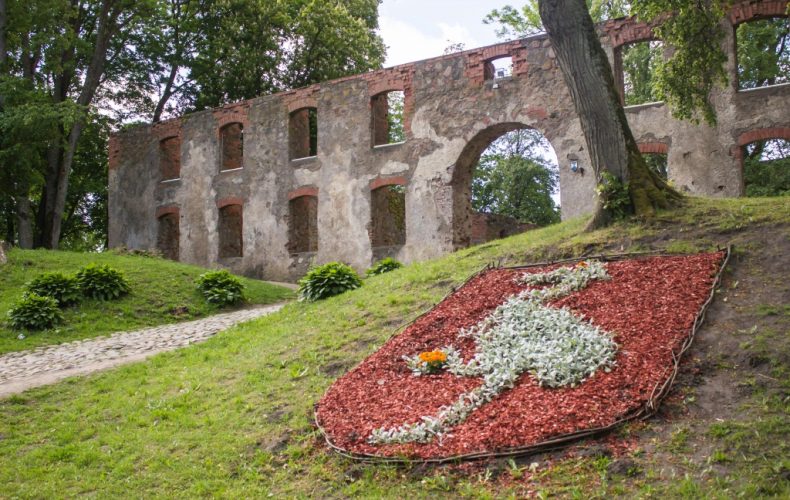
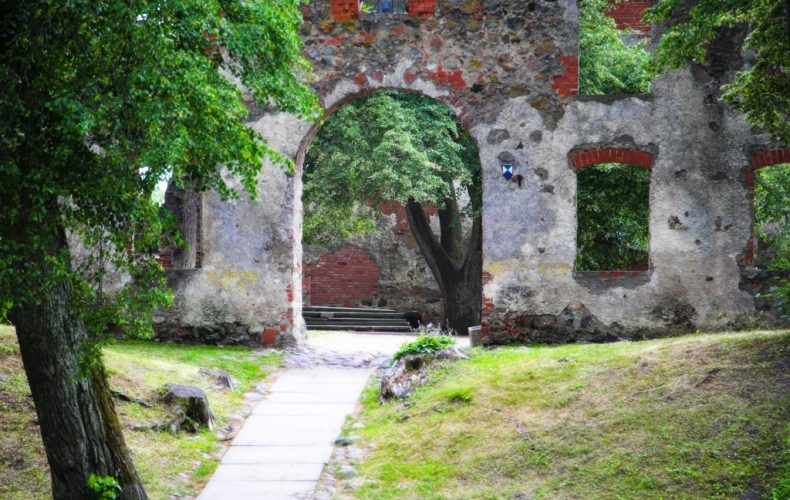
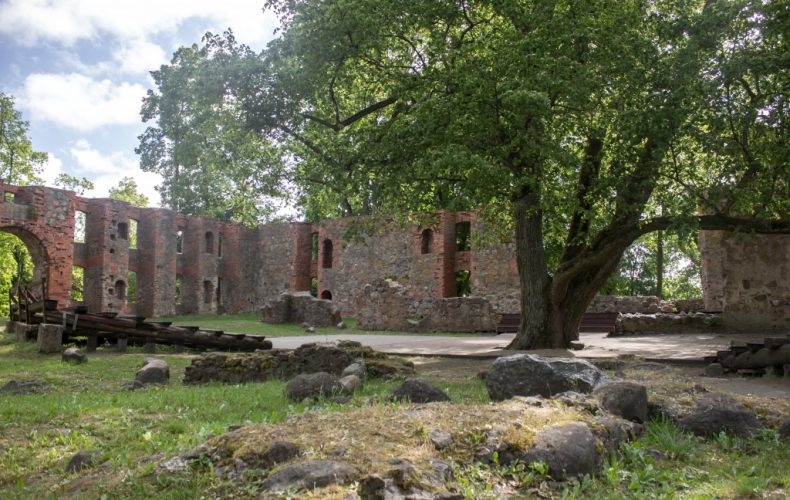


The construction of the medieval castle in Grobiņa dates back to the 13th century. The medieval castle of Grobiņa was first mentioned in historical sources as Hus to Grobin. It is believed to have been made of wood, as it was burnt down in 1263. The castle was rebuilt in 1328. It is located next to the Grobin castle mound – in Kurzeme it was typical to build castles in the immediate vicinity of ancient Curonian castle mounds. The castle was an important military fortification for centuries until it lost its military significance as a result of the wars of 1795 and 1812. During its lifetime, the castle has been repaired and modernised several times. The medieval walls have survived to the present day, the 17th-century castle walls have been restored.
Researchers believe that the medieval castle of Grobiņa with its bastions was built on an ancient Scandinavian settlement, which is why it has been included in the transnational serial nomination “Viking Age sites in Northern Europe” for the UNESCO World Heritage List.
The legend of the medieval castle of Grobiņa
GrobiņaCastle is said to have been very beautiful and rich. There were two underground passages under the castle, one leading to the church and the other to the Ilgi Cemetery. A knight once lived in this castle and had a very beautiful daughter. The owner of the castle married his daughter off to a noble young man, but the girl did not like the young man. The knight was an orphan with his subjects. They sent the captured Whigs to do the hardest jobs.
The disobedient Whigs were kept in underground prisons. Once, among the captured Whanginiks was a handsome young man who refused to submit. They imprisoned him in one of the underground cellars. The young lady took a liking to the young man and decided to rescue him. The brave woman took the young man through the underground passages to the Ilgi Cemetery.
The young man escaped, but the young lady was imprisoned and thrown alive into one of the underground passages of the castle by her cruel father and husband. People say that even nowadays, the sound of a woman’s moaning can be heard from underground in the Grobiņa Castle area.
The archaeological ensemble of Grobiņa consists of several archaeological monuments of the same period: the Grobiņa hillfort (Skābarža Hill) and ancient town, the medieval castle of Grobiņa with its bastions, the Priediena hillfort, the Atkalnu hillfort, the Smukumu hillfort and the Porāni hillfort, which are compactly located in Grobiņa and its immediate surroundings. These monuments mostly date back to the 7th-9th centuries. They are associated with an impressive Scandinavian colony, which is also mentioned as Seeburg (Jurpils) in the 9th century.
The archaeological ensemble of Grobiņa is an authentic and very well preserved collection of mainly Viking-age archaeological sites and structures. The richness and diversity of the material recovered from the archaeological excavations shows that Grobiņa was one of the most important Viking sites of its time in the eastern Baltic Sea. Therefore, the monuments of the Grobiņa archaeological ensemble are included in the transnational serial nomination “Viking sites in Northern Europe” for the UNESCO World Heritage List.
Photos from the Grobiņa TIC archive