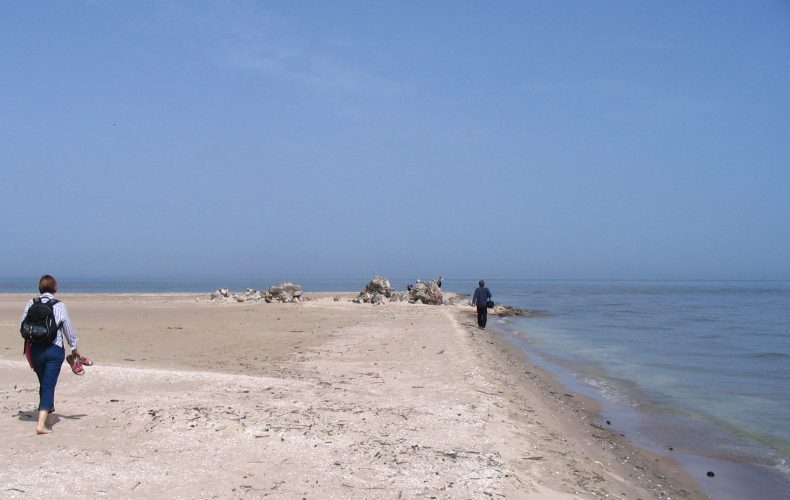
The history of Kolkasrags lighthouses dates back to the 13th century, when signal fires were lit here so that sailors could determine the turning point between the Irbe Strait and the Gulf of Riga. The cape, from which the shoal extends 6 km, has always been dangerous for shipping, and the ship graveyard that has been built on it is the largest in the Baltic Sea.
Here, on an underwater cliff, Sur mer meets Piškis mer (in Livonian, the Great Sea and the Little Sea).
The first wooden lighthouse tower, with a fire at its top, was mentioned in 1532. In the middle of the 16th century, there were two lighthouses, which formed a line of lighthouses along the axis of the shoal. The turn had to be made when the fires of the two lighthouses were above each other and seemingly merged into one. In 1818 the fires were replaced by oil lamps – the light was continuous or, as sailors say, solid. The operation of the Kolka lighthouses was taken over by Ostensakens, the owner of the Dundaga manor, for more than 3 thousand silver roubles a year.
During the Crimean War, British sailors vandalised the lighthouses, and in 1858 the towers were repaired and the shore at the North Lighthouse tower was strengthened. Twenty years later the tower was destroyed by the sea. The South Tower was used as a ship movement and ice observation point.
Today, only fragments of the ruins of the old lighthouse remain.
Photos from the Talsi TIC archive.